Group your endpoints and deep dive into attributes
by Rae McKelveyThe endpoint list in your project tells you which endpoint you're looking at. But when you're running an application across many devices, you need more context: which environment is it in? What version is it running? Where is it deployed?
iroh-services 2.0 adds endpoint groups and attributes, giving you more ways to organize endpoints and attach context from your application. Here's a look:
Give your endpoints a group
Each endpoint can belong to a single named group. You might use staging and
production to describe deployment environments, or canary for endpoints
trying out a new release. Choose names that make sense for your application.
Set the group at startup with ClientBuilder::group(), or update it while the
client is running with Client::set_group(). Moving an endpoint to a different
group doesn't require rebuilding the client.
Add the details with attributes
Attributes are custom key-value pairs attached to an endpoint. Use them for details such as region, app version, or device type. A group gives an endpoint one place to belong; attributes let you describe it along several dimensions.
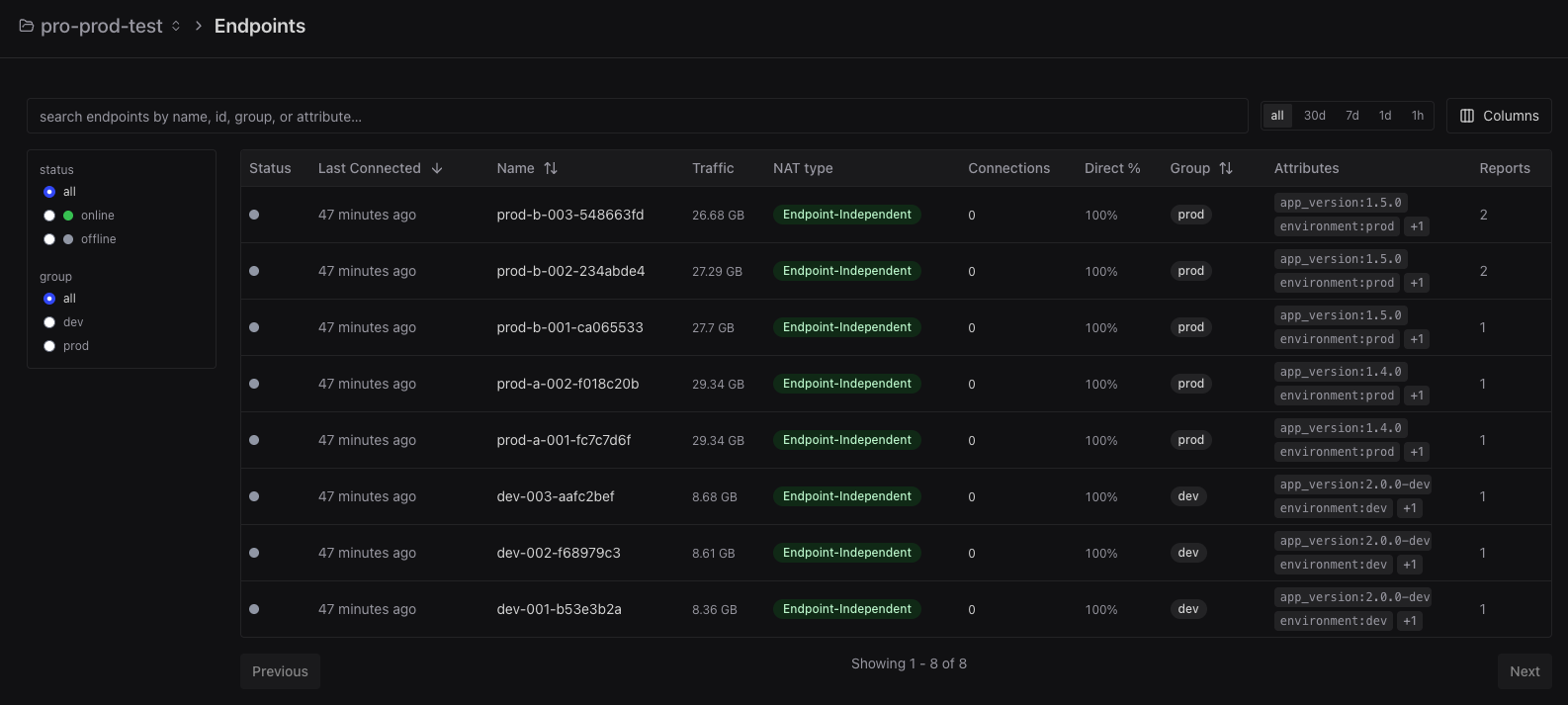
Groups and attributes in the endpoint list. Select the image to view it full size.
You can set both when you build your client:
let client = Client::builder(&endpoint)
    .api_secret_from_env()?
    .group("production")?
    .attributes([
        ("warehouse_id", "DEF234"),
        ("app_version", "2.0.0"),
    ])?
    .build()
    .await?;

// Update metadata as your application changes.
client.set_attribute("app_version", "2.0.1").await?;
client.set_group("canary").await?;
Each endpoint supports up to 128 attributes.
More reliable metrics and diagnostics in the browser
This release also improves metrics delivery. Clients re-authenticate and resend the metrics schema after reconnecting, fixing an issue that could stop metrics from being processed after a connection broke.
Client::shutdown() now attempts a final metrics flush before stopping. Call
it before closing your endpoint to give metrics collected since the last
interval a chance to reach the service.
Network diagnostics now support WebAssembly, bringing connectivity reports to applications running in the browser.
Updating to 2.0
This release includes breaking API changes. Protocol types move into
iroh-services-proto, and the client API no longer exposes rcan or irpc
types directly. Applications should continue depending on iroh-services.
If you match on errors, Error::Rpc now wraps anyhow::Error, and Error and
BuildError are non-exhaustive. The unused BuildError::Connect and
BuildError::Rpc variants have been removed.
Try groups and attributes with your own endpoints on Iroh Services, or start with the endpoint metadata example for a runnable version of the setup above.
To get started, take a look at our docs, dive directly into the code, or chat with us in our discord channel.