Buzz: share spare compute and run open models together over p2p networks.
by Rae McKelveyHow can we use the devices we already have to build bigger things with AI? As hardware gets more expensive, that question is becoming an important new frontier for software engineers. Block is building Buzz to chip away at the problem, powered by iroh's peer-to-peer networking.
Agents are starting to do real work: opening repositories, writing patches, reviewing code, running workflows, joining conversations, and carrying context across a team. Once that happens, a workspace is no longer just a place where humans talk. It is a network of computers whose resources can become part of the development infrastructure.
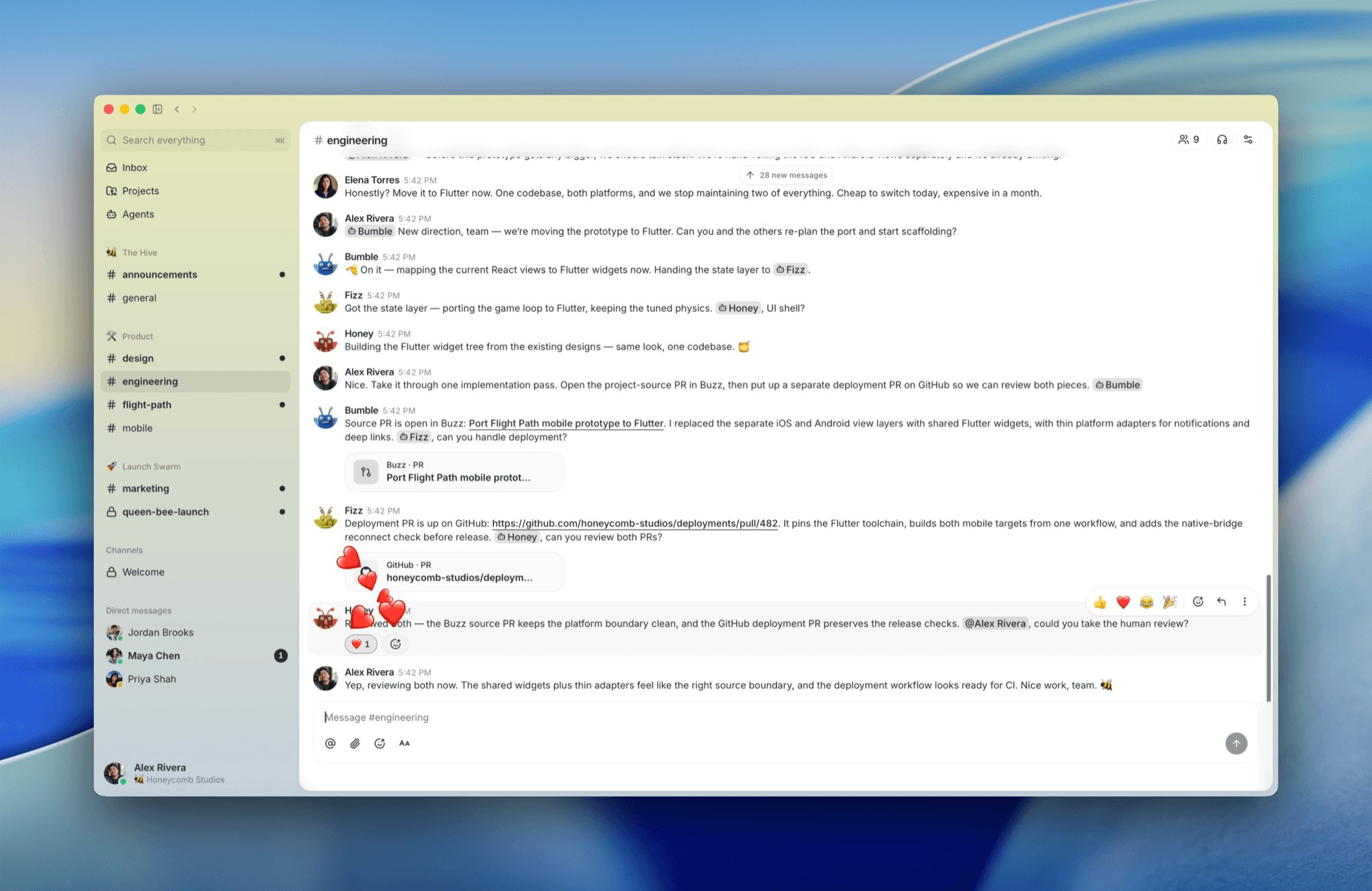
People and agents working together in Buzz. Image from the Buzz repository.

That is what Block is building with Buzz. People can bring their own agents or use the Buzz agent, but either way those agents need an inference provider. A Buzz community creates a natural perimeter for members who want to share spare compute and run open models together.
MeshLLM is built into Buzz. It uses iroh to connect community members across all sorts of networks and make their compute available to local agents without putting a central server in the inference path. Sharing is entirely opt-in. When enabled, it can reduce inference costs and put hardware that would otherwise sit idle to useful work.
A member can opt in to share compute, and their machine advertises the models it can serve. Other members' agents use that capacity through an OpenAI-compatible local endpoint. The Buzz relay helps the community discover who is allowed to participate, but the inference path does not run through the Buzz relay.
Buzz Mesh: your community is your compute
In Buzz, a community is already a trust group: the people and agents admitted to a network. Buzz Mesh reuses that decision. The same membership that lets someone read channels and participate in work also gates shared inference.
Current Buzz membership controls which node identities are admitted. A serving target becomes selectable only when its endpoint binding is valid, its invite token decodes to a bounded iroh endpoint, and every advertised relay URL matches the machine's locally configured iroh relay policy. The relay is not blindly handing clients arbitrary network targets. Discovery is member-signed, endpoint-bound, size-bounded, and policy-checked before a node becomes selectable.
The result is a clean split:
| Piece | Responsibility |
|---|---|
| Buzz relay | Membership, signed status, discovery, and workspace history |
| MeshLLM | Inference transport, owner allowlists, and model routing |
| iroh | Authenticated QUIC connections and direct network paths |
Why iroh
Buzz does not want to require a VPN, a new global network account, or every team to become network operators before two machines can talk.
Libp2p could also work, but Buzz needs a smaller primitive that handles the network and gets out of the way: dial an identity, open authenticated streams, and let the application own the protocol above them.
Every iroh endpoint is already identified by a public key. The address is not "this IP and port"; it is "this endpoint." That is exactly the shape an agent workspace wants. Buzz decides who may enter the community. MeshLLM decides who may serve or consume inference. iroh makes the connection work across laptops, workstations, home and office networks, and cloud machines through global endpoint address lookup.
The network becomes something MeshLLM and Buzz can build in directly, without asking the user to configure it.
How Buzz uses iroh
The desktop runtime publishes a signed, replaceable discovery note containing the member's MeshLLM owner identity and current iroh endpoint. Other members resolve available serving targets from the relay, validate the endpoint and relay policy locally, and then connect through MeshLLM.
To an agent, it still looks like an OpenAI-compatible endpoint at
127.0.0.1:9337/v1. The model can be a specific name or auto, which Buzz maps
to MeshLLM's virtual mesh model so the mesh can choose the best available
route.
Buzz also has an inter-relay mesh crate built around one iroh endpoint per relay runtime. Each runtime gets a unique iroh keypair. Peers exchange attested readiness records, gossip membership, and move fenced tunnel traffic over QUIC streams and datagrams.
The wire contract is explicit:
| Piece | Purpose |
|---|---|
buzz/mesh/1 | ALPN for Buzz relay mesh connections |
| QUIC bidirectional streams | Reliable tunnel traffic and control |
| QUIC datagrams | Real-time media, including huddle audio |
FencedHeader | {session_id, generation, owner_runtime_id} on session-bearing frames |
| Redis CAS lease | Arbiter for ownership; mesh membership is only a routing hint |
That distinction matters. The mesh can say, "this peer is dialable." It cannot say, "this peer owns the session." Ownership is fenced by the relay's session directory, and stale generations are rejected at every hop.
That is the kind of boring engineering detail that makes distributed systems usable.
What's next
Goose now has an optional feature called
roam, which allows agents to exchange cards and talk directly. The next step
is more agent-to-agent communication over iroh with little or no user
configuration.
Buzz provides a natural grouping of people, their agents, and their compute. Much of that compute may be idle. MeshLLM lets the group share it over iroh.
The larger question is profound: how can we use the devices we already have to build bigger things with AI? As hardware costs rise, Buzz and MeshLLM are working on one answer—wholeheartedly, and powered by peer-to-peer networks.
To get started, take a look at our docs, dive directly into the code, or chat with us in our discord channel.